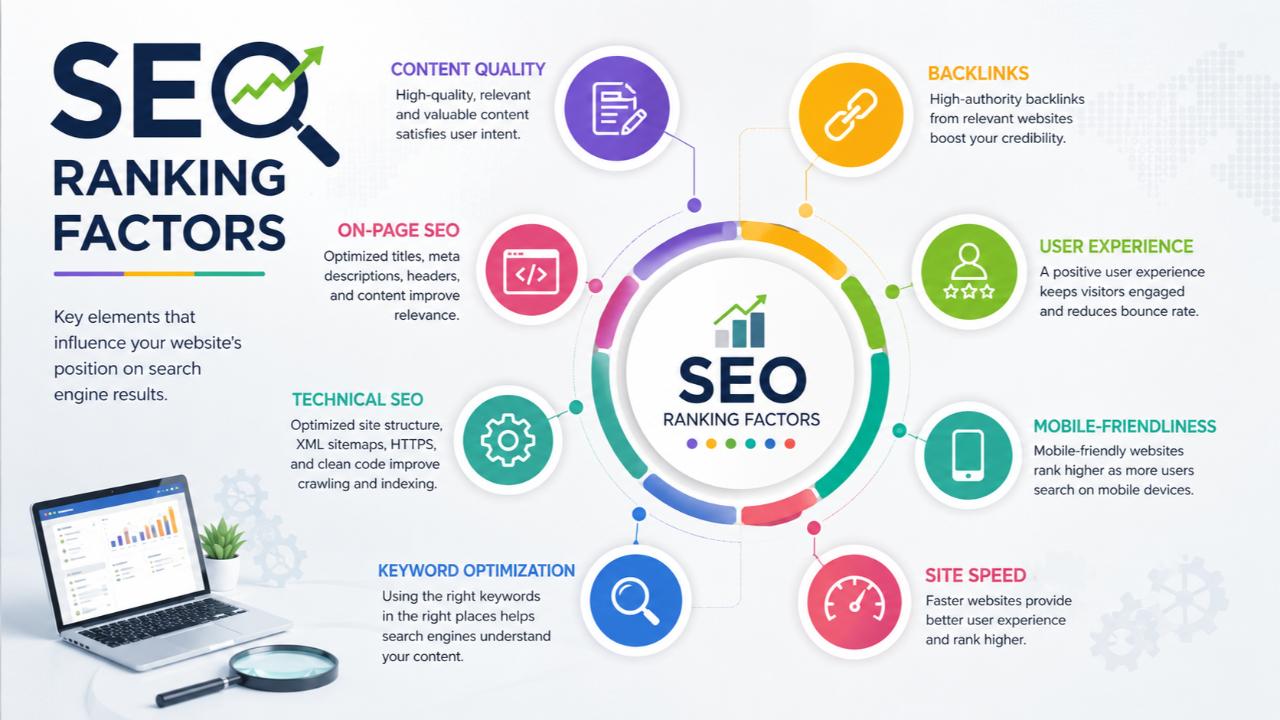
Ever wonder why some websites always show up on the first page of Google, while others (maybe even yours) are stuck on page 5? It’s not luck. It’s not magic. It comes down to something called SEO ranking factors the things Google looks at before deciding who deserves the top spot.
The problem is, most SEO articles make this sound way more complicated than it needs to be. So let’s fix that. In this guide, we’ll explain the main ranking factors in plain, simple language no confusing tech talk, just what you actually need to know.
What Is an SEO Ranking Factor, Really?
Think of Google like a very picky judge in a competition. Every website is a contestant. Google’s job is to pick the best ones and put them at the top of the results page.
To decide who wins, Google checks things like:
- Is the content actually useful?
- Does the website load fast?
- Do other websites trust and link to it?
- Is it easy to use on a phone?
These checks are called ranking factors. The better you score on them, the higher you can rank.
1. Good Content Comes First
This is the most important one, hands down. If your content doesn’t help the reader, nothing else really matters.
Good content means:
- It answers the question people are actually searching for
- It’s easy to read, with short sentences and simple words
- It’s not copied from somewhere else
- It gives real value, not just filler words to hit a word count
Simple tip: Before you write anything, ask yourself, “If I were searching this, what would I actually want to know?” Then write that.
2. Use Keywords, But Naturally
Keywords are just the words people type into Google. If someone searches “best coffee shops in Delhi,” that’s a keyword.
You don’t need to stuff your content with the same keyword over and over. Google is smart now it understands related words and phrases too. So just write naturally, and include your main keyword a few times in a way that feels normal, like you’re talking to a person, not a robot.
3. Backlinks Still Matter
A backlink is when another website links to your page. Think of it like a recommendation. If a trusted, popular website links to you, Google sees that as a sign that your content is valuable too.
You don’t need hundreds of backlinks. A few good ones from real, relevant websites are much more powerful than a big pile of low-quality ones.
4. Your Website Needs to Be Fast and Easy to Use
Nobody likes a slow website. If your pages take too long to load, people leave and Google notices that.
A few basics that help a lot:
- Make sure your site loads quickly (a few seconds, not 10+)
- Make sure it works well on mobile phones, not just computers
- Fix broken links and pages that don’t work properly
- Use HTTPS (the little lock icon in the browser) for security
5. Match What People Are Actually Looking For
This one is simple but often missed. If someone searches “how to bake a cake,” they want a recipe not a long article about the history of baking.
Before writing content, check what kind of results are already showing up on Google for that keyword. That tells you exactly what format people expect (a list, a guide, a comparison, etc.), and matching that gives you a much better shot at ranking.
6. Show That You Know What You’re Talking About
Google likes content written by people who clearly understand the topic. This is often called E-E-A-T, which just means: Experience, Expertise, Authority, and Trust.
In simple terms, this means:
- Write like someone who actually understands the topic
- Add real examples or experience where you can
- Keep information accurate and updated
- Be someone (or a brand) people can trust
7. Mobile-Friendly Is a Must, Not a Bonus
Most people now search on their phones, not their computers. So if your website looks broken or hard to read on mobile, you’re losing out both with users and with Google rankings.
8. Keep People Engaged
If someone clicks on your page and leaves immediately, that’s not a good sign. Google notices when people stay longer, read more, or click around your site. Simple ways to keep people engaged:
- Break up long paragraphs
- Use headings so people can scan easily
- Add helpful visuals or examples
- Make sure your content is genuinely worth reading till the end
9. Local SEO (For Local Businesses)
If you run a local shop, restaurant, or service, there are a few extra things that help:
- Set up and complete your Google Business Profile
- Keep your name, address, and phone number the same everywhere online
- Get real reviews from real customers
- Use location-based keywords, like “bakery in Delhi” instead of just “bakery”
10. Images and Videos Matter Too
Text isn’t the only thing Google looks at. Images and videos can also help your page rank better, as long as you use them the right way.
A few simple things to do:
- Give your images clear file names, like “chocolate-cake-recipe.jpg” instead of “IMG1234.jpg”
- Add alt text, which is just a short description of what the image shows
- Don’t use huge, heavy image files that slow your page down
- Add a video if it genuinely helps explain something better than text alone
This doesn’t just help SEO it also makes your page more enjoyable for real visitors.
11. Internal Linking Helps More Than People Think
Internal linking simply means linking from one page on your website to another page on your own website. For example, if you write a blog post about “healthy breakfast ideas,” you could link to another post you have about “easy smoothie recipes.”
Why this matters:
- It helps Google understand how your pages are connected
- It keeps visitors on your site longer, since they have more to explore
- It helps spread “trust” from your strongest pages to newer or weaker ones
A simple habit: every time you publish new content, go back and link to it from a few older, related posts.
12. Don’t Ignore Old Content
A lot of people focus only on writing new blog posts and forget about the old ones. But old content can quietly lose rankings over time if it becomes outdated.
Every few months, it’s worth going back to your older posts and:
- Updating any outdated facts, prices, or examples
- Adding new sections if the topic has changed
- Fixing broken links
- Improving the writing if it feels rushed or thin
This is often called a “content refresh,” and it can bring back rankings and traffic without writing anything brand new.
13. Trust Signals on Your Website
Beyond just content, Google also looks at whether your website feels trustworthy overall. Some simple trust signals include:
- A clear “About Us” page that explains who you are
- Easy-to-find contact information
- A privacy policy, especially if you collect any user data
- Genuine reviews or testimonials, if relevant to your business
None of these are complicated to add, but together they help both Google and real visitors trust your website more.
A Simple Recap
| Ranking Factor | In Simple Words |
| Good content | Actually helps the reader |
| Keywords | Used naturally, not stuffed |
| Backlinks | Other trusted sites linking to you |
| Site speed | Loads fast, works well on mobile |
| Search intent | Matches what people are really looking for |
| E-E-A-T | Shows real knowledge and trust |
| Engagement | Keeps people reading and clicking |
| Local SEO | Helps local businesses show up nearby |
| Images & videos | Add value and improve the experience |
| Internal linking | Connects your pages and spreads trust |
| Content refresh | Keeps old posts relevant and ranking |
| Trust signals | Shows visitors and Google you’re credible |
Final Thoughts
SEO doesn’t have to be confusing. At the end of the day, Google is just trying to show people the most helpful, trustworthy, and easy-to-use websites. So if you focus on writing genuinely useful content, keeping your site fast and mobile-friendly, and earning a few good backlinks, you’re already doing most of what matters.
You don’t need to master everything overnight. Pick one or two things from this list, improve them first, and build from there.
Want Help Ranking Your Website?
SEO gets a lot easier once you know what actually matters. If you’d like help turning these basics into a real strategy for your website, feel free to reach out for a simple, no-jargon SEO consultation.
Frequently Asked Questions
They’re the things Google checks before deciding which websites deserve to rank higher, like content quality, site speed, and backlinks.
Good, helpful content that actually answers what the searcher is looking for.
Not always, but having a few good backlinks from trusted websites definitely helps, especially for competitive keywords.
Usually a few weeks for easier keywords, and 3 to 6 months for more competitive ones.
Yes, local businesses also need to focus on things like Google Business Profile, reviews, and location-based keywords.