
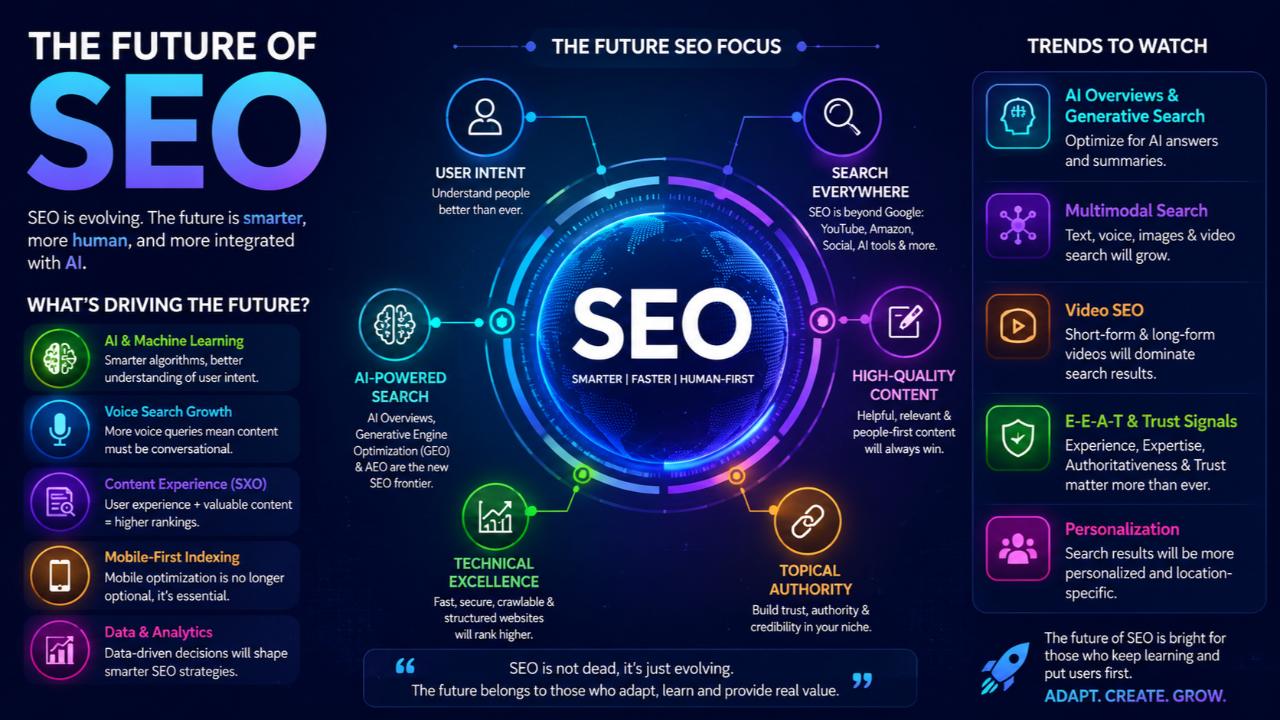
SEO has never been a “set it and forget it” game. But right now, in 2026, the gap between what SEO used to be and what it’s becoming feels bigger than ever before.
A few years ago, ranking on Google meant finding the right keywords, building backlinks, and making sure your meta tags were clean. Simple enough, right? But if you walked into a room of SEO professionals today and tried that same playbook, you’d get some polite nods and a lot of quiet concern.
The future of SEO is here and it’s fundamentally different from what came before.
AI-powered search. Conversational queries. Zero-click results. Search Generative Experience. Voice assistants answering questions before users even click on a result. These aren’t distant predictions anymore. They’re already reshaping how people find information and how businesses earn visibility.
This article breaks down what the future of SEO actually looks like, what trends are driving the biggest changes, and most importantly, what you need to do right now to make sure your content and your business stay relevant and visible in the years ahead.
Why Traditional SEO Is No Longer Enough
Let’s start with an honest reality check.
The old model of SEO was largely mechanical. Find a high-volume keyword, write a 1,500-word article stuffed with that keyword, get a few backlinks, and wait to rank. It worked for years. And in some cases, it still gets results today.
But Google and search behavior itself has evolved in ways that make purely mechanical SEO increasingly unreliable. Here’s why:
- Google’s algorithm is no longer just counting keywords. It’s trying to understand meaning, context, and the actual intent behind a query.
- Users have changed how they search. People now type (or speak) full questions rather than choppy keyword strings.
- AI is transforming the search results page itself. Google’s AI-generated summaries now appear above organic results, which means even a #1 ranking doesn’t guarantee traffic the way it used to.
- Trust is now a ranking factor. Google explicitly rewards content that demonstrates real experience, genuine expertise, and trustworthy authorship.
The future of search engine optimization belongs to brands and creators who understand people first and algorithms second.
Trend #1 — AI-Powered Search Is Rewriting the Rules
The biggest shift happening in SEO right now is the rise of AI-generated search results. Google’s Search Generative Experience (SGE) now evolving into what many call AI Overviews places an AI-generated summary directly at the top of the search results page.
This changes everything about how clicks are distributed.
Before, the top three organic results captured most of the traffic. Now, if an AI summary fully answers the user’s question, many users won’t scroll down to organic results at all. This phenomenon is contributing to the rise of what researchers call “zero-click searches.”
What this means for your SEO strategy:
- Content that gives quick, direct answers still has value but only if you’re the source the AI cites.
- To be cited in AI summaries, your content needs to be genuinely authoritative, well-structured, and factually accurate.
- Brands with weak or generic content that previously ranked on keyword stuffing will see sharp declines in visibility.
- Building topical authority covering a subject comprehensively across many pieces of content becomes more important than ever.
The future of SEO is about being a trusted source that AI models point to, not just a page that shows up in a blue link list.
Trend #2 — E-E-A-T Is Now the Foundation of Rankings
Google’s quality evaluator guidelines introduced E-A-T (Expertise, Authoritativeness, Trustworthiness) a few years ago. Then they added an extra E Experience making it E-E-A-T.
This addition isn’t small. It signals that Google now wants to see real, lived experience behind content not just formal credentials or theoretical knowledge.
What E-E-A-T means in practice:
- A blog post about “best hiking boots for beginners” carries more weight if written by someone who has actually hiked and tested the boots, not just scraped Amazon reviews.
- Medical, financial, and legal content needs to be authored or reviewed by actual qualified professionals.
- Author bios, bylines, credentials, and transparency about who created the content matter more now.
- First-person insights, original data, case studies, and personal perspectives help signal genuine experience.
For B2B businesses in particular, this trend is a major opportunity. If your team has deep domain expertise that isn’t being showcased in your content, that’s a gap worth closing right now.
The future of search engine optimization rewards real knowledge shared by real people and Google is getting much better at telling the difference.
Trend #3 — Voice and Conversational Search Are Growing
Voice search is no longer niche. With smart speakers, phone assistants, and AI chatbots all responding to spoken queries, a growing percentage of searches are now conversational in nature.
People don’t say “best CRM software small business” to their phone. They say, “Hey, what’s the best CRM software for a small business with a team of 10?” That’s a very different search pattern and it requires a different content approach.
How to optimize for voice and conversational search:
- Target long-tail, question-based keywords (what, how, why, which, when).
- Create FAQ sections that mirror how real people ask questions in natural language.
- Write content that answers specific questions clearly and concisely before elaborating.
- Optimize for featured snippets these are the source that voice assistants most commonly read aloud as their answer.
- Use structured data (schema markup) to help search engines understand your content’s context.
Think of your content less as a document and more as a conversation. The brands that write for human ears not just for search engine crawlers are going to win in voice search.
Trend #4 — Zero-Click Searches and How to Adapt
This one is uncomfortable but important to talk about.
Zero-click searches are searches where the user gets their answer directly on the search results page through a featured snippet, knowledge panel, AI overview, or answer box — and never clicks through to any website.
Studies suggest that more than half of all searches now end without a click. For informational queries especially, this number continues to grow.
Does this mean SEO is dying? Absolutely not. But it does mean the value of SEO needs to be thought about differently.
How to adapt to the zero-click reality:
- Don’t just chase traffic chase visibility and brand recognition. Even if users don’t click, they see your brand name as the source of information. That builds trust over time.
- Focus on transactional and commercial keywords where users need to visit a website to complete an action (buy something, book a demo, sign up).
- Optimize for featured snippets even if they reduce clicks being the chosen answer builds authority.
- Use SEO alongside email and community building so you’re not entirely dependent on search traffic for business results.
- Invest in brand search when people search your company name specifically, that traffic is nearly impossible to lose to AI overviews.
Zero-click doesn’t mean no value. It means the game has evolved from traffic generation to authority and visibility management.
Trend #5 — Video SEO Is Becoming Non-Negotiable
Text-based content is not going away. But video is growing as a search format at a pace that B2B marketers and content creators can no longer ignore.
YouTube is the second-largest search engine in the world. Google increasingly surfaces YouTube videos in standard search results. And with the rise of short-form video, even platforms like TikTok and Instagram are functioning as search engines for younger audiences.
What video SEO looks like in practice:
- Optimize YouTube video titles, descriptions, and tags with target keywords.
- Create transcripts and captions for every video these are indexed by search engines.
- Use timestamps and chapters to make long-form videos more navigable (Google indexes these).
- Embed videos on relevant blog pages to increase time-on-page and content depth.
- Create short-form video content that answers common questions in your niche this drives both discovery and trust.
If your SEO strategy is entirely built around written content and you haven’t invested in video yet, that’s a real gap in your future-proofing plan.
Trend #6 — Topical Authority Over Keyword Targeting
Here’s a mindset shift that defines the future of SEO strategy: Google no longer just rewards individual pages that rank for a keyword. It rewards websites that demonstrate comprehensive expertise across an entire topic.
This is called topical authority — and it’s become one of the most important concepts in modern SEO.
Instead of writing one post about “email marketing tips,” a topically authoritative site covers email marketing from every angle: list building, deliverability, A/B testing, subject lines, segmentation, automation sequences, compliance, and more. The result is that Google begins to see the site as a genuine authority on the subject and ranks its content more broadly and more consistently.
How to build topical authority:
- Create content clusters: a comprehensive pillar page on a broad topic supported by detailed sub-topic posts that link back to it.
- Cover your niche deeply and consistently before expanding to new topics.
- Interlink related content intelligently this tells Google how your content relates and helps it understand your site’s expertise map.
- Update and improve older content rather than just constantly producing new pieces.
- Avoid spreading too thin across unrelated topics focus wins.
Building topical authority is a long-term play, but once you establish it, it creates a compounding advantage that’s very hard for competitors to displace.
Trend #7 — Technical SEO Is Getting More Complex
As AI and personalization shape search results, the technical side of SEO is evolving too. Core Web Vitals, page experience signals, site architecture, and structured data have moved from “nice to have” to table stakes.
Technical SEO priorities for the future:
- Core Web Vitals: Page loading speed, visual stability, and interactivity remain ranking factors. Slow websites lose rankings.
- Mobile-first indexing: Google uses the mobile version of your site as the primary version for indexing. If your mobile experience is weak, your rankings suffer.
- Structured data (Schema markup): Helps search engines understand your content and increases your chances of appearing in rich results like FAQs, How-Tos, product ratings, and more.
- Site architecture: Clean, logical site structure with smart internal linking helps crawlers find and index your content efficiently.
- Crawl budget management: For large sites, making sure Google’s crawler isn’t wasting time on low-value pages is increasingly important.
Technical SEO won’t make bad content rank. But weak technical SEO will absolutely prevent great content from reaching its potential.
What the Future of SEO Means for Your Strategy Right Now
So, putting this all together what should you actually do differently?
Here’s a practical framework:
1. Write for humans, then optimize for search. Stop writing content that sounds like it was produced by a keyword targeting tool. Write like a knowledgeable friend explaining something to another person. Then add appropriate keywords, headers, and structure.
2. Invest in E-E-A-T signals. Make sure your content reflects real experience. Add author bios with credentials. Cite original data. Share personal insights and case studies. Build your brand’s reputation as a trustworthy source.
3. Build topical clusters, not just individual posts. Pick your core topics and cover them comprehensively over time. Quality and depth beat quantity and breadth.
4. Don’t ignore video. Even simple, talking-head explainer videos or short-form answers to common questions can dramatically increase your visibility and time-on-site.
5. Think beyond clicks. Track branded search volume, content shares, email subscribers, and direct traffic alongside organic click metrics. SEO in 2026 is about building an ecosystem of trust, not just harvesting keyword traffic.
6. Keep technical fundamentals strong. Speed, mobile experience, structured data, and clean architecture are not optional extras anymore they’re the floor.
Final Thoughts
The future of SEO isn’t scary it’s just different. And honestly, in many ways, it’s better.
The changes happening in search are pushing brands away from shortcuts and toward something more sustainable: real expertise, genuine helpfulness, and content that actually serves the person reading it. The businesses that adapt that build authority, invest in quality, and meet users where they actually are will find SEO more powerful, not less.
The brands that hold onto old tactics, chase keyword density, and ignore AI-driven search changes will find themselves increasingly invisible.
The choice, as always in digital marketing, is pretty simple. Evolve or get left behind.
Start now. Build smart. Stay consistent. The future of search engine optimization rewards those who are willing to grow with it.