
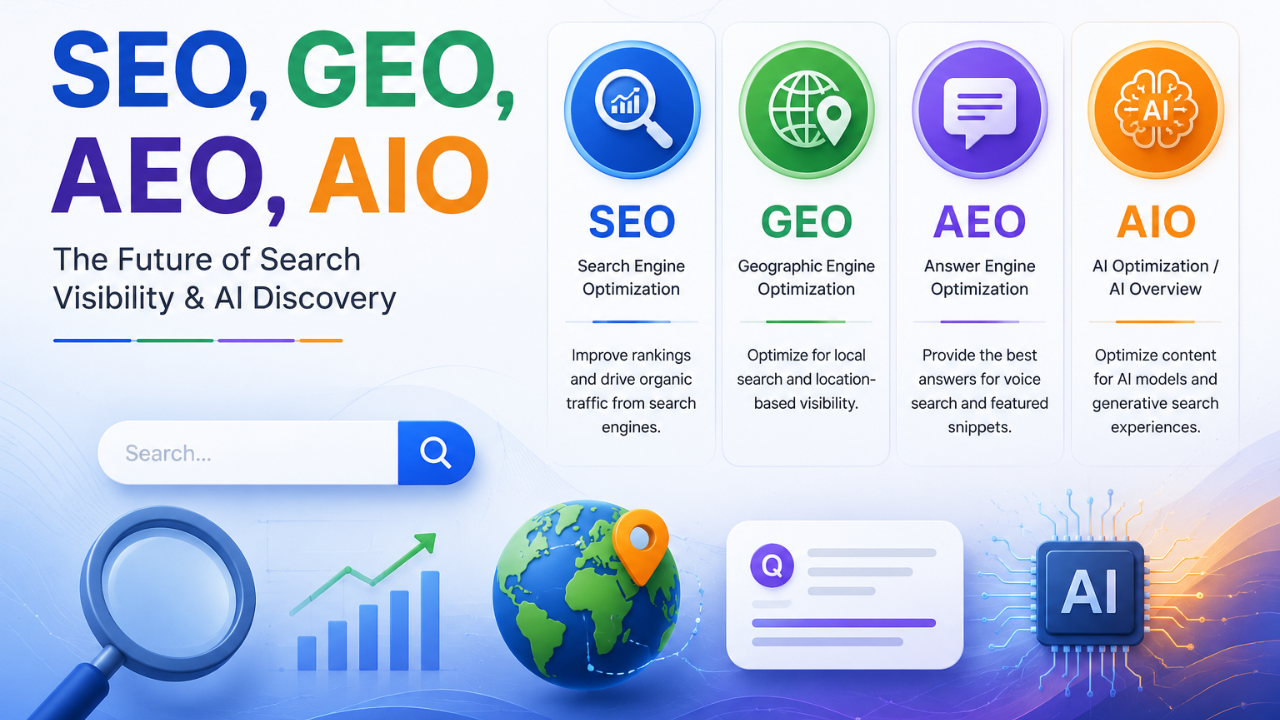
If you’ve spent any time in digital marketing lately, you’ve probably noticed something strange happening. SEO isn’t just SEO anymore. Suddenly everyone’s throwing around GEO, AEO, AIO, and a handful of other acronyms like it’s a game of alphabet soup. And if you’re feeling a little lost, you’re not alone.
Here’s the truth: search itself is splitting into different channels. People aren’t just typing queries into Google and scrolling through blue links anymore. They’re asking ChatGPT. They’re getting instant answers from Google’s AI Overviews. They’re talking to voice assistants. Each of these channels needs a slightly different optimization strategy, and that’s exactly where these new acronyms come from.
This guide breaks down what SEO, GEO, AEO, and AIO actually mean, how they’re different, where they overlap, and how you can start using all of them together to stay visible no matter how someone chooses to search.
What is SEO (Search Engine Optimization)?
Let’s start with the one you already know. SEO stands for Search Engine Optimization, and it’s the practice of optimizing your website and content so it ranks higher on traditional search engines like Google and Bing.
SEO covers things like:
- Keyword research and placement
- On-page optimization (titles, meta descriptions, headers)
- Technical SEO (site speed, mobile-friendliness, crawlability)
- Backlink building and domain authority
- Content quality and relevance
The goal of SEO has always been simple: rank higher, get clicked, drive organic traffic to your website. For over two decades, this was the entire game. If you ranked on page one, you won.
But here’s the catch. Google itself has changed. A huge share of searches today end without anyone clicking a link at all, because the answer is already sitting right there on the results page. That single shift is the reason new optimization disciplines had to be born.
What is AEO (Answer Engine Optimization)?
AEO stands for Answer Engine Optimization. Instead of just trying to rank, AEO is about becoming the direct answer to a question.
Think about featured snippets, “People Also Ask” boxes, voice assistant replies (Siri, Alexa, Google Assistant), and zero-click results. When someone asks “how many calories in a banana” and Google shows the answer instantly at the top of the page, that’s AEO in action.
The difference between SEO and AEO comes down to intent:
- SEO optimizes for rankings. You want position one.
- AEO optimizes for selection. You want to BE the answer, whether or not you’re technically in position one.
To win at AEO, content needs to be structured for extraction. That means clear, concise answers near the top of a section, FAQ formatting, structured data and schema markup, and direct language that a machine can easily lift and present as an answer.
What is GEO (Generative Engine Optimization)?
Now here’s where things get genuinely new. GEO stands for Generative Engine Optimization, and it’s built specifically for the world of AI chatbots and generative search tools like ChatGPT, Perplexity, Google’s Gemini, and Claude.
GEO is the practice of creating content that these AI tools trust enough to cite or reference when generating an answer for a user. Unlike traditional search, where a user clicks through to your site, a generative AI tool might read your content, synthesize it, and hand the user a summary directly, sometimes with a citation, sometimes without one.
This is a genuinely different relationship with your audience. Your “visitor” might literally be an AI model reading your page rather than a human. The upside is that when these tools do cite your content, you can gain credibility and traffic from an entirely new channel. Even when there’s no visible citation, your ideas and data still shape the answer the user receives, which quietly builds brand exposure.
GEO tends to reward content that is:
- Well-structured with clear headings and logical flow
- Backed by original data, statistics, or unique insights
- Recently published or updated (freshness matters a lot here)
- Written with authority and clear sourcing
Some marketers use GEO and AEO almost interchangeably, and honestly, there’s a lot of overlap. But GEO leans specifically toward generative AI platforms, while AEO covers a broader range of answer formats, including non-AI features like voice search and featured snippets.
What is AIO (AI Optimization / AI Overviews)?
AIO is where things get a little more specific, and also a little more confusing, because the acronym gets used two different ways.
- AI Overviews — This refers specifically to Google’s AI-generated summary boxes that now appear at the top of many search results. Optimizing to appear in these boxes is sometimes called AIO.
- AI Optimization — Used more broadly, this refers to the overall practice of optimizing your brand’s presence and visibility across all AI tools, not just Google’s.
The key distinction to remember: AEO is the broader discipline of optimizing for any answer engine, while AIO usually points to Google’s specific AI Overview feature. If GEO is about being cited across the whole AI ecosystem, AIO is often about winning that one particular real estate spot inside Google’s results page.
And More: Other Terms Worth Knowing
Since this space is evolving so fast, a few more acronyms have started showing up in marketing conversations:
- LLMO (Large Language Model Optimization): This is essentially the technical subset of GEO. It focuses specifically on how large language models retrieve, process, and cite content, often through retrieval-augmented generation (RAG) pipelines. If you’re already doing solid GEO work, you’re likely doing most of LLMO too.
- Geographic SEO (Local SEO): Not to be confused with GEO. This is a completely different discipline focused on ranking for location-based searches, like “best bakery near me.”
- LLM SEO: Another informal term some practitioners use interchangeably with GEO or AEO, referring generally to optimizing for large language model visibility.
The labels can overlap and the industry hasn’t fully agreed on strict definitions yet. What matters more than memorizing every acronym is understanding the underlying shift: search is no longer just about ranking, it’s about being referenced, trusted, and reused by both humans and machines.
SEO vs GEO vs AEO vs AIO: A Quick Comparison
| Term | Focus | Where It Shows Up |
| SEO | Ranking on search engines | Google, Bing organic results |
| AEO | Being selected as the direct answer | Featured snippets, voice assistants, PAA boxes |
| GEO | Being cited by generative AI | ChatGPT, Perplexity, Claude, Gemini |
| AIO | Winning AI-generated summaries | Google AI Overviews specifically |
Why This Matters More Than Ever
A growing share of searches today end without a single click to a website, and that number keeps climbing as AI-generated answers become the default experience for many users. Some estimates suggest a meaningful chunk of traditional search volume could shift toward AI chat tools in the near future, as more people go straight to a chatbot instead of a search bar.
If your content strategy still relies purely on classic SEO, you risk becoming invisible in exactly the channels where your audience is increasingly starting their research journey. The brands and creators winning in 2026 aren’t choosing one discipline over another. They’re layering SEO, AEO, and GEO together, using strong technical and content foundations from SEO, structuring for direct answers with AEO, and building authority and citation-worthy content with GEO.
How to Start Optimizing for All Four
You don’t need to overhaul your entire strategy overnight. Here’s a practical starting point:
- Keep your SEO foundation strong. Good keyword targeting, fast-loading pages, and clean site structure are still the backbone of visibility.
- Answer questions directly. Add clear, concise answers near the top of your sections, and use FAQ schema wherever it fits naturally.
- Build genuinely useful, original content. AI tools favor content with unique data, clear structure, and real expertise over generic, recycled information.
- Keep content fresh. Update old posts with current information and statistics rather than letting them go stale.
- Use structured data and schema markup. This helps both traditional search engines and AI tools understand and extract your content accurately.
Conclusion
The search landscape isn’t shrinking, it’s multiplying. SEO hasn’t disappeared, but it’s no longer the only game in town. GEO, AEO, and AIO represent the new layers of visibility that come with an AI-driven search experience, and ignoring them means leaving a growing chunk of your potential audience undiscovered.
The good news is that none of this requires starting from scratch. It requires building on what you already know about good content and layering in a few new habits: answering questions clearly, structuring content for extraction, and staying fresh and authoritative enough that both humans and AI models want to reference you. Ready to future-proof your content strategy? Start by auditing one existing blog post today: tighten up your answers, add an FAQ section, and see how it performs. Small, consistent changes across your content library will add up to real visibility across search engines, answer engines, and AI platforms alike.