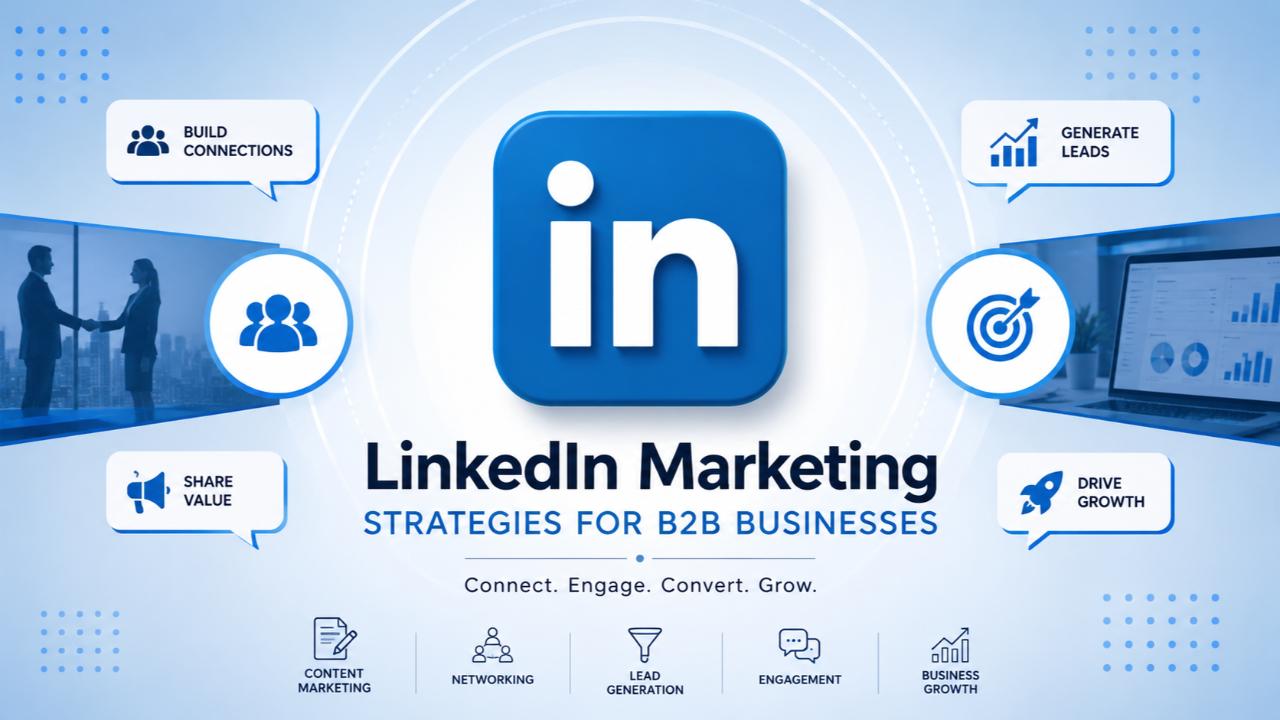
If you run a B2B business and you’re not taking LinkedIn seriously yet, you’re leaving money on the table. Plain and simple. While platforms like Instagram and TikTok get all the buzz, LinkedIn quietly remains the most powerful platform for reaching decision-makers, generating qualified leads, and building real business relationships.
Think about it this way when was the last time you closed a six-figure deal because someone saw your brand on Instagram Reels? Probably never. But LinkedIn? That’s where procurement managers, CEOs, marketing directors, and founders actually spend time researching vendors, checking out companies, and making buying decisions.
In this guide, we’re going to walk through practical, no-fluff LinkedIn marketing strategies for B2B businesses that actually move the needle. Whether you’re a startup trying to get noticed or an established company looking to scale your pipeline, these strategies will help you turn LinkedIn into a genuine growth engine.
Why LinkedIn Matters So Much for B2B Companies
Before jumping into tactics, let’s quickly understand why LinkedIn deserves a dedicated spot in your marketing budget.
LinkedIn is built around professional identity. People don’t go there to watch dance videos they go there to network, learn, hire, and do business. This single difference changes everything about how content performs and how leads convert.
Here’s what makes LinkedIn uniquely valuable for B2B marketing:
- Decision-makers are active there. Most B2B buyers, including senior executives, regularly check LinkedIn.
- Higher intent audience. People engaging with business content are often already in research or buying mode.
- Better lead quality. Leads generated through LinkedIn tend to convert better compared to many other social platforms because the targeting is professional, not just demographic.
- Long-term trust building. Consistent, helpful content builds credibility over months, which directly impacts sales cycles that are often long in B2B.
Now let’s get into the actual strategies.
1. Optimize Your Company Page Like It’s a Landing Page
A lot of B2B businesses treat their LinkedIn company page as an afterthought just a logo and a one-line description. That’s a missed opportunity.
Your company page is often the first impression a potential client gets. Treat it like a landing page that needs to convert.
What to fix:
- Write a clear, benefit-driven “About” section that explains what problem you solve, not just what you do.
- Use a banner image that communicates your value proposition visually.
- Add a strong call-to-action button (Visit Website, Contact Us, Learn More).
- Keep your page updated with recent posts, milestones, and product updates.
- Add relevant hashtags and industry tags so you show up in searches.
A polished company page builds instant credibility, especially when prospects check you out after a sales call or a referral.
2. Build Personal Brands, Not Just a Company Page
Here’s something most B2B marketers underestimate: people trust people more than they trust logos.
Posts from individual employees, especially founders, sales leaders, and subject-matter experts, typically get far more engagement and reach than posts from a company page. This is one of the most effective LinkedIn marketing strategies for B2B businesses that’s still underused.
How to do this well:
- Encourage your founders and leadership team to post regularly about industry insights, lessons learned, and behind-the-scenes thoughts.
- Get your sales team active too they’re closest to customer pain points and can share relatable content.
- Avoid overly polished, corporate-sounding posts. Authentic, slightly imperfect writing performs better than press-release style content.
- Comment and engage as individuals, not just as a brand page.
When your team consistently shows up with valuable opinions and insights, your company becomes associated with expertise and that builds trust long before a sales call happens.
3. Create a Content Strategy Centered Around Value, Not Promotion
One of the biggest mistakes B2B brands make on LinkedIn is treating it like a billboard. Constant “buy our product” posts get ignored, or worse, muted.
Instead, focus on a content mix that educates, informs, and occasionally promotes.
A good content mix looks like this:
- 60% educational content (how-tos, industry trends, frameworks, mistakes to avoid)
- 20% engagement content (questions, polls, opinions, discussions)
- 15% social proof (case studies, testimonials, results)
- 5% direct promotion (product launches, offers, demos)
Content formats that perform well on LinkedIn for B2B:
- Carousel posts (PDF documents) breaking down a process or framework
- Text-only posts sharing a strong opinion or lesson
- Short native videos explaining a concept
- Data-backed posts with charts or stats
- Client success stories told as narratives, not just numbers
The goal is to become a useful presence in your audience’s feed, not just another brand trying to sell something.
4. Leverage LinkedIn Articles and Newsletters for Authority Building
LinkedIn’s native publishing tools Articles and Newsletters are still underutilized by most B2B brands, which makes them a great opportunity.
Publishing long-form content directly on LinkedIn (instead of just linking out to your blog) keeps people on the platform and signals expertise.
Why this works:
- LinkedIn often favors native content in its algorithm over external links.
- Newsletters allow you to build a subscriber base that gets notified every time you publish.
- It positions your brand or executives as thought leaders in a specific niche.
Start a newsletter around a specific theme relevant to your industry something like “Weekly B2B Growth Insights” or “SaaS Sales Playbook” and publish consistently. Over time, this builds a loyal, niche audience that trusts your perspective.
5. Use LinkedIn Sales Navigator for Targeted Outreach
If your team is doing outbound prospecting, LinkedIn Sales Navigator is one of the most underrated tools in the B2B toolkit.
It allows you to filter prospects by job title, company size, industry, seniority level, and even recent activity making your outreach far more targeted than generic cold emailing.
Best practices for outreach:
- Don’t pitch immediately. Engage with a prospect’s content first (like, comment thoughtfully).
- Personalize connection requests based on something specific about their role or recent post.
- Follow up with value, not just a sales pitch share a resource, insight, or relevant case study.
- Use Sales Navigator’s saved searches and alerts to stay updated on new prospects matching your ideal customer profile.
The key here is patience. LinkedIn outreach works best as a relationship-building channel, not a spray-and-pray sales tactic.
6. Run Targeted LinkedIn Ads for High-Intent Audiences
Organic reach is valuable, but LinkedIn Ads can accelerate results, especially for B2B companies with longer sales cycles and higher deal values.
Effective LinkedIn ad formats for B2B:
- Sponsored Content: Native-feel posts promoted to a targeted audience.
- Message Ads: Direct messages sent to prospects’ inboxes (use sparingly and with genuine value).
- Lead Gen Forms: Pre-filled forms that reduce friction for downloading resources or booking demos.
- Document Ads: Promote gated content like whitepapers or case studies directly within the feed.
Targeting tips:
- Layer your targeting using job title + company size + industry for precision.
- Retarget website visitors who didn’t convert with a specific offer.
- Test ABM (Account-Based Marketing) campaigns targeting specific named accounts you want to land.
LinkedIn Ads tend to have a higher cost-per-click than other platforms, but the lead quality and conversion rate often justify the spend for B2B offers with strong lifetime value.
7. Use Employee Advocacy to Multiply Your Reach
Your employees collectively have a much bigger network than your company page. Employee advocacy turns your team into a distributed content engine.
How to encourage this:
- Make it easy by sharing pre-written post templates or talking points (without sounding robotic).
- Recognize and celebrate employees who actively engage and share company content.
- Create a simple internal habit for example, a Slack channel where new posts are shared for the team to engage with.
Even simple actions like employees liking and commenting on company posts can significantly boost organic reach due to how LinkedIn’s algorithm prioritizes engagement velocity.
8. Engage in Relevant LinkedIn Groups and Communities
LinkedIn Groups aren’t as flashy as they used to be, but niche, active groups still offer real value for B2B networking and visibility.
How to use groups effectively:
- Join groups where your ideal customers are likely to be active.
- Don’t just drop links participate in discussions and answer questions genuinely.
- Share insights occasionally that naturally showcase your expertise without being salesy.
This is a slower strategy but builds long-term goodwill and visibility within tightly-knit professional communities.
9. Use Data and Analytics to Refine Your Strategy
LinkedIn provides decent native analytics for both company pages and individual posts. Use them.
Metrics worth tracking:
- Engagement rate (likes, comments, shares relative to impressions)
- Click-through rate on links and CTAs
- Follower growth rate over time
- Lead form conversion rate for ad campaigns
- Best-performing content types and topics
Review this data monthly and adjust your content calendar based on what’s actually resonating. Don’t keep producing content types just because you assume they’ll work let the data guide you
10. Be Consistent Because LinkedIn Rewards Patience
Here’s the honest truth: most B2B businesses give up on LinkedIn too early because they don’t see instant results. But LinkedIn marketing, like most B2B marketing, is a compounding game.
Posting once and disappearing for three weeks won’t build authority. Consistent posting ideally 3 to 5 times a week across company and personal profiles combined with genuine engagement is what eventually creates momentum.
Set a realistic content calendar, assign ownership within your team, and commit to at least 90 days before judging results. Most B2B brands that “win” on LinkedIn are simply the ones that stuck with it longer than their competitors.
Common Mistakes to Avoid
- Over-automating engagement. Bots and generic automated comments are easy to spot and hurt credibility.
- Ignoring comments. Failing to reply to comments kills the engagement loop LinkedIn’s algorithm relies on.
- Only posting product updates. Nobody wants a feed full of “we just launched a new feature” posts.
- Inconsistent posting. Sporadic activity confuses the algorithm and your audience.
- Treating LinkedIn like a resume site only. It’s now a full content and lead generation platform use it that way.
Final Thoughts
LinkedIn isn’t just another box to check in your marketing plan for B2B businesses, it’s arguably the single most valuable platform available today. The combination of professional intent, decision-maker access, and content-driven trust-building makes it uniquely suited for long sales cycles and relationship-based selling.
The strategies covered here optimizing your company page, building personal brands, focusing on value-driven content, leveraging Sales Navigator, running targeted ads, and staying consistent aren’t shortcuts. They require effort and patience. But for B2B businesses willing to invest the time, LinkedIn consistently delivers some of the highest quality leads and the strongest brand authority of any platform available right now. Start small, stay consistent, and let your expertise do the talking. Over time, LinkedIn can become one of your most reliable channels for pipeline generation and long-term brand trust.